









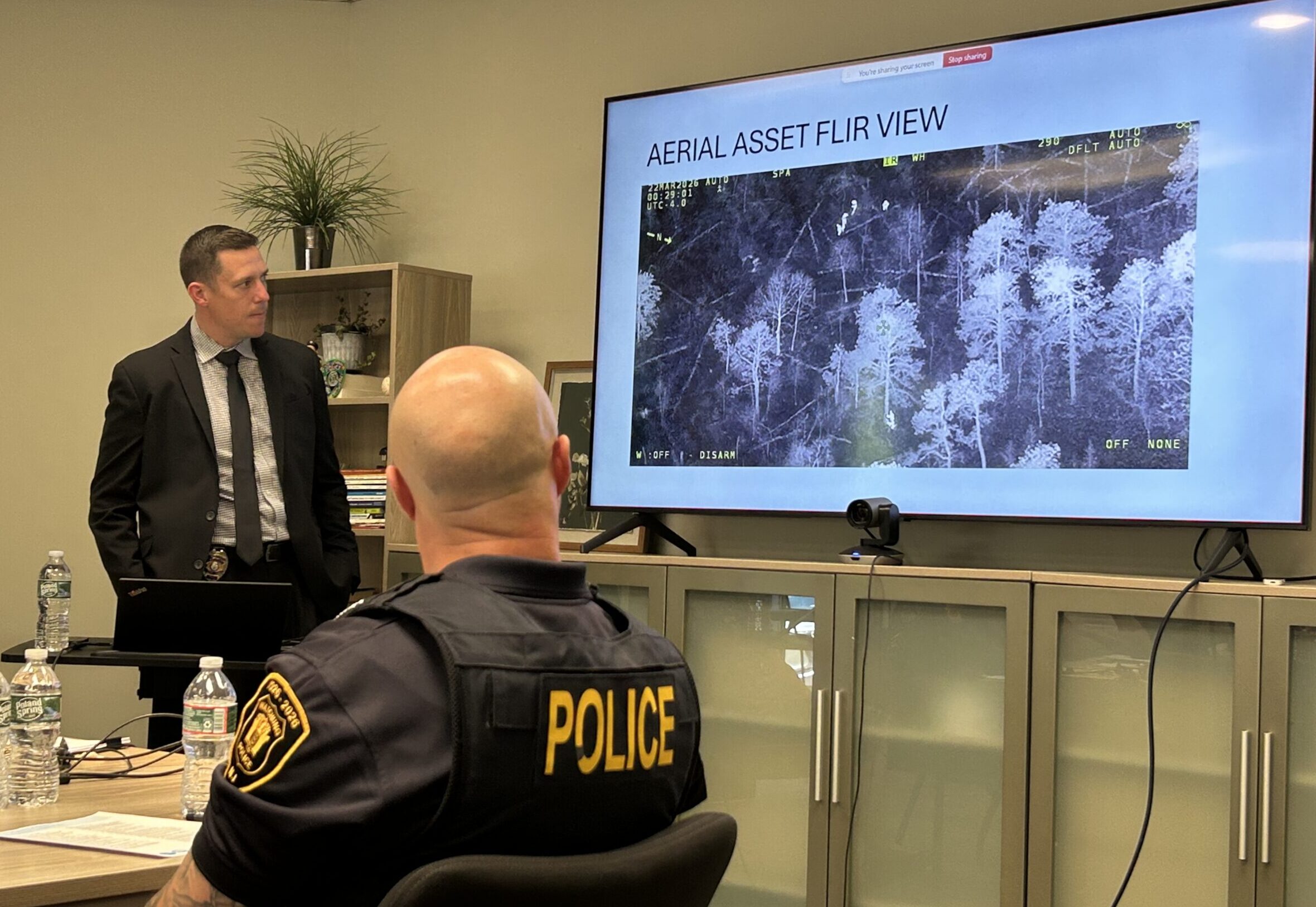
Pictured: Sgt. Fair shows LEAC a clip from drone infrared footage of officers headed into the woods to rescue Joel.
How coordination, training, and technology helped bring a missing autistic teenager home
In the minutes before Joel Medina was reunited with his parents, the autistic teenager can be heard on a recording calling out, “Mom and Dad? Mom and Dad?” Moments later, when he finally sees them, his voice changes: “Mom and Dad,” he declares, without question.
Joel emerged from dense, thorny woods early morning on Sunday, March 22, nearly 36 hours after he wandered away from his home in Egg Harbor Township. His safe rescue was the result of a coordinated effort of local police officers, New Jersey State Police K9 teams, and FBI personnel.
From the start, officers understood they were searching for a teenager with autism, limited communication skills, and history of wandering. Those details prompted an immediate, multi-agency response. Nearly half of children with autism wander from safe settings, and many are drawn to water with a limited understanding of danger. From 2011-2016, about 30% of wandering incidents involving individuals with autism in the US were fatal or required medical attention, while another 38% involved close calls with hazards such as traffic or water, according to the National Autism Association.
Too often, law enforcement examines cases marked by missteps or tragic outcomes. This case offered something different: a chance to understand what went right.
“We’re highlighting a win and seeing what we can learn from it,” Egg Harbor Township Police Detective Sgt. Brett Fair said as he presented Joel’s case to Autism New Jersey’s Law Enforcement Advisory Committee (LEAC), which includes officers from across the state. Several members are parents of children with autism and expressed fear that their own kids would wander someday.
 On the day Joel disappeared, he was in the front yard of his home, a place he often went to stim or self-soothe when upset. That Friday afternoon, he was outside in shorts, a T-shirt and sneakers after his dad told him to lower the volume on his iPad, Sgt. Fair said. His parents checked on him regularly, as they typically did. When they realized he was no longer in the yard, they looked for about 10 minutes before his mom called 911.
Joel had wandered before and had been found relatively quickly, so the situation did not initially appear urgent, Fair said.
Officers began by searching Joel’s typical location near the wooded area by his home. When he wasn’t found, K9 units and drones were deployed. That evening, officials canvassed the neighborhood, checking yards, sheds, RVs, and boats. Neighbors were asked to check their surveillance cameras. Detectives conducted a second search of the Medina home, checking the attic, the crawl space, and the shed, and re-interviewed Joel’s parents, asking them to complete a detailed autism questionnaire to better understand him.
By Saturday, Joel was still missing. Search efforts intensified. Drones were redeployed, surveillance footage was reviewed more systematically, and additional search-and-rescue teams from multiple counties joined the effort. A dive team searched nearby bodies of water, while mounted patrol combed through dense brush and high terrain in the woods.
Later that day, authorities accepted an offer from the FBI to deploy a drone capable of covering a wider area. It was equipped with forward-looking infrared (FLIR) technology, which can distinguish body heat against cold surroundings.
Around 12:30 a.m. Sunday, the drone observed a human next to a tree in the woods.
It took time for rescuers to reach Joel. Police body camera footage captured the moment officers found him, cold, confused and frightened.
“I can’t find my mom and dad,” he told rescuers.
Sgt. Fair was among those on scene when Joel was found, about half a mile from his home, nearly a day-and-a-half after he went missing. Officers had to guide Joel through the difficult terrain for more than 40 minutes before reuniting him with his family.
“That was one of the most rewarding experiences of my professional career,” Sgt. Fair said.
Sgt. Fair identified several key factors that made the response effective. Coordination. Communication. The use of an autism questionnaire. And, as Sgt. Fair emphasized, a willingness to set egos aside and do what was needed, regardless of rank. The case also highlighted opportunities for improvement. Fewer initial assumptions. More training for personnel on an app that allows searches to be tracked live. More understanding of the steps needed to get tech companies to release video footage from surveillance cameras.
“The case was a master class in multi-agency coordination and law enforcement’s dedication to protecting some of the most vulnerable members of our community,” said Doreen Yanik, director of Autism New Jersey’s Law Enforcement Initiative. “Sgt. Fair provided insights that resonated with everyone in attendance, both professionally and emotionally. The presentation strengthened the shared commitment among LEAC members to ensure the safety of the autism community.”
Joel had only minor scrapes on his hands, arms and legs. He was not wearing locative technology when he wandered, but he is now, Fair said.
Devices such as GPS tracker AngelSense and radio-based systems like Project Lifesaver are among 12 autism-friendly practices identified by LEAC to foster positive and safe interaction between officers and individuals on the spectrum.
Joel’s story is a reminder that every successful outcome offers lessons that can help protect others.
For more information about LEAC’s work, view our Autism-Friendly Practices for Law Enforcement publication. For more information about wandering and elopement, read this article on our website.