






By Dr. Suzanne Buchanan, Psy.D., BCBA-D, LBA, Executive Director of Autism New Jersey
During Autism Acceptance Month, you may see local businesses, schools and police departments hosting special events and engaging with their communities. Thanks to each and every one of them, New Jersey is far more “autism friendly” than it was when Autism New Jersey was founded in 1965.
What does autism friendly mean? And why should it matter to you?
Being autism friendly is a year-round, lifelong commitment to building communities where a child can receive understanding medical care, a teenager can take part in sports without judgment, an adult can safely interact with police and families feel supported wherever they go.
In New Jersey, more than 242,000 individuals fall on the autism spectrum, according to Autism New Jersey’s analysis of Census and Centers for Disease Control and Prevention data. It is called a spectrum because social interaction, communication and sensory processing look different for every person. For some individuals, these differences come with more significant support needs. We calculate that more than 64,000 have profound autism, which includes an IQ below 50, limited verbal ability and the need for 24/7 supervision.
It was only a few generations ago that people with autism were institutionalized, isolated and dismissed as incapable. Parents were blamed. Doctors turned families away. Schools refused to educate. Police officers lacked training to respond safely to someone in distress.
For more than 60 years, Autism New Jersey has worked to change that narrative by replacing fear with knowledge and exclusion with access. Today, thanks to research, improved practices and lived experience, we know that when individuals with autism are understood and supported, they can thrive. Families feel safer. Communities grow stronger.
So, imagine this:
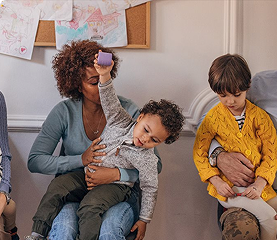
Your child with profound autism has been inconsolable for days, and you can’t figure out why. They can’t tell you what hurts, but you know something is wrong. You take them to the doctor, hoping for answers and relief.
But when you walk inside the doctor’s office, the fluorescent lights hum. The smell of disinfectant is strong. The nurse insists your child stand still on the scale. Your child drops to the floor, overwhelmed. They scream. They thrash. Staff grow visibly frustrated. Other patients stare.
Feeling embarrassed and judged, you leave without the help you came for.
This wasn’t your fault, or your child’s. It’s a system that wasn’t built for someone who experiences the world differently.
This isn’t fiction. It’s a real-life story that our 800.4.AUTISM Helpline staff hear all the time. It’s why we created our Advancing Healthcare Initiative and are working with doctors and hospitals to create more autism-friendly spaces across New Jersey.
Being autism friendly means anticipating those moments and working to prevent them.
It means health care providers offer sensory and scheduling accommodations, and staff participate in training so that patients can be examined in a safe and dignified way.
In law enforcement, an autism-friendly New Jersey means officers use communication strategies that reduce escalation. It means voluntary identification programs that provide critical information in emergencies. It means using technology that helps locate a missing vulnerable adult in minutes, not hours.
Our Law Enforcement Initiative, started in 2024, identified 12 evidence-based best practices to improve safety and trust between officers and the autism community. Departments across New Jersey are implementing them. Our Advancing Healthcare Initiative is following a similar path.
This work is intentional, thoughtful and replicable. And it is working.
Because here is the reality: Individuals with autism are more likely to encounter law enforcement. More likely to experience anxiety and depression. More likely to face physical health challenges. More likely to wander or bolt. And far too often, they encounter environments that misunderstand them or are unprepared.
Being autism friendly isn’t just a sound bite. It saves lives.
And in an everyday sense, it makes life better. Expanding this mindset into municipalities, businesses, sports venues and houses of worship helps ensure that people with autism aren’t left out of their own communities. Inclusion isn’t just symbolic. It’s structural.
Thankfully, so many members of the community are becoming more autism friendly. Sports stadiums, entertainment venues and airports have created quiet spaces for people with autism to escape being overwhelmed. “Social stories,” or instructive narratives, help them to understand fire drills, classroom participation, trick-or-treating or whatever else is going on around them. Major retailers and movie theaters offer sensory-friendly events.
Being autism friendly should matter to all of us. Because when a community learns to support people with autism and other disabilities, it doesn’t help just those individuals. The practices that help an autistic child to navigate a doctor’s visit can help every patient feel more at ease. The training that helps an officer to support a person in crisis strengthens public safety for everyone.
Together, we can create a New Jersey where inclusion isn’t something we talk about once a year; it’s something we practice every day. Where every person, regardless of how they experience the world, is met with understanding, respect and opportunity.